St Phillip's Church War Memorial, Penn
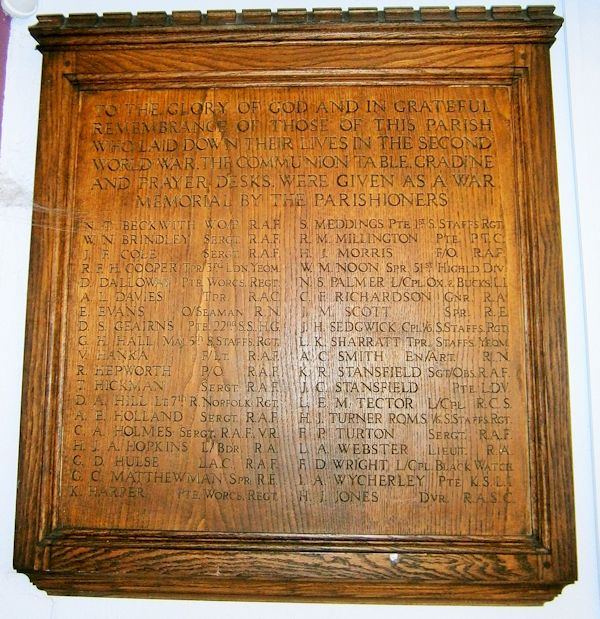
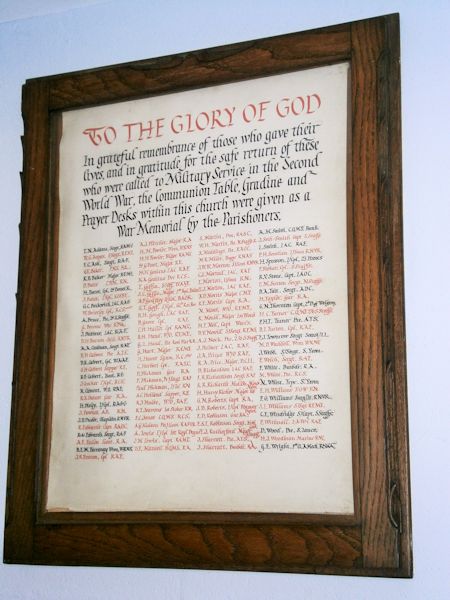
Beckwith Norman Thomas Warrant Officer 1430238
33 Sqdn. Royal Air Force Volunteer Reserve
Norman was born 9 March 1922 in Leeds son of Herbert and Elsie Agnes Beckwith. By 1939 they were living at 2 Langley Road, Bradmore, Wolverhampton along with Norman's younger brother Geoffrey and maternal grandmother Fanny Bywater. He was employed as a Civil servant and volunteered as an A.R.P. Messenger in his Civil Defence Role.
Norman enlisted at RAF Cardington, Bedfordshire sometime after April 1941.
Norman was killed on 29 December 1945, aged 23, while flying a Hawker Tempest (serial number SN116). The aircraft struck trees and crashed while flying low near Fassberg, the crash site was recorded as being near Celle, about 20 miles north-east of Hanover.
13. A. 12. Hanover War Cemetery, Germany.
Brindley William Norman Wireless Operator/Air Gunner Sergeant 938689
51 Sqdn. Royal Air Force Volunteer Reserve, based at RAF Dishforth, North Yorkshire.
William was born 24 February 1921 in Wolverhampton son of Edward and Edith Brindley. In 1921 they were living at 300 Horden Road, Wolverhampton, along with William's older siblings Dorothy and Edward. By 1939 they had moved to 234 Trysull Road, Wolverhampton and were joined by Frederick who was born in 1922. William was employed as a shop assistant at Hattons a hardware store.
William enlisted into the RAF at Cardington, Bedfordshire sometime between September 1939 and August 1940.
The Whitley bomber in which William was flying took off at 19:00 hours 3 April 1940 from Dishforth. The aircraft was accidently shot down by Hurricane V6960 of 87 Sqdn when returning from a raid on Brest and crashed astride a hedge at Connegar Farm a few hundred yards East of Manston village church, Newton, Dorset. William was killed but the four remaining crew members survived uninjured.
Ironically Hurricane V6960 of 87 Sqdn was mistakenly shot down by a RAF Beaufighter and destroyed by fire near Haselbury Plucknett, Somerset, on 12 May 1941.
The pilot, Sergeant D. Castle, survived but was injured and badly burned while returning from this patrol.
William was killed 3 April 1941 aged 19.
Grave 9. Dishforth Cemetery, North Yorkshire.
Cole James Frederick Sergeant 1215655
12 Sqdn. Royal Air Force Volunteer Reserve.
James was born 28 March 1923 in Fulham Greater London son of Leonard James Cole and Sarah Elizabeth Cole, he was baptised 22 April 1923 at St Johns, Waltham Green. Between 1921 and 1939 the family moved to Wolverhampton from Fulham. In 1939 they were livng at 241/3 Trysull Road, Wolverhampton along with James' older siblings Leonard and Winifred. James was employed as a opticians mechanic.
James enlisted into the RAF at Cardington, Bedfordshire sometime after April 1940.
The Lancaster bomber in which James was flying took off from RAF Wickenby, Lincolnshire, 2/3 December 1943 it crashed at Blankenfelde, on the outskirts of Berlin, about seven miles west of the city centre, during a raid on the target.
James was killed in action 3 December 1943 aged 20.
He is commemorated on Runnymede Memorial, Panel 145.
Cooper Richard Fred Harry Trooper 7953805
3rd County of London Yeomanry (Sharpshooters) Royal Armoured Corps.
Richard was born 6 December 1922 in Wolverhampton son of Richard and Rose Cooper. In 1939 they were living at 8 Penn Road, Wolverhampton along with Richards younger sister Mary.
The war diary records - 'on the night of 4/5 October 1943, the regiment was ordered by 78th Division to send one squadron to 11th Brigade and one to 36th Brigade in the Termoli area [on the Adriatic coast of Italy]. At first light, the situation on the 11th Brigade front was judged most critical, so C Squadron crossed the Biferno River first and went into action immediately.
After six tanks crossed, the ford became unusable, and the blown bridge under continuous enemy shelling, could not be repaired by the Royal Engineers until 1420 hrs. C Squadron remained in action throughout.
Meanwhile, 36th Brigade on the left flank was being heavily attacked on the high ground at Difesa Grande, with enemy tanks and infantry threatening to drive the British infantry off and cut the road into Termoli and isolate 11th Brigade.
Once the bridge was repaired, B Squadron crossed by 1430 hrs and was ordered to counter-attack up the high ground. Regimental HQ and the reserve squadron followed, turning the action into a full regimental operation. The regiment then suffered losses when concealed Mark IV Specials knocked out two B Squadron tanks and one RHQ tank and an outflanking move on the right was held by further enemy fire.
They advanced about a mile, overran enemy infantry positions, took 20 prisoners, and captured several machine guns.
As light failed, the infantry consolidated the limited ground gained.' Seven men were killed and twelve were wounded Richard was in one of the two B Squadron tanks knocked out by the German forces.
Richard was killed in action 5 October 1943 aged 20.
Remembered on Panel 2 Cassino Memorial, Italy.
Dalloway Dennis Private 4915690
7th Bn. Worcestershire Regiment.
Dennis was born in June 1919 in Wolverhampton, the son of Annie Dalloway. By 1921, he and his mother were living at 7 Ash Street, Wolverhampton, the home of his maternal grandmother, Mary Dalloway, and his aunt, Nellie Dalloway.
The 7th Battalion Worcestershire Regiment was a Territorial Regiment and Dennis' service number 4915690 shows he was almost certainly a prewar Territorial soldier and not in the 1939 Register because he was already mobilised.
The 7th Battalion sailed from Southampton on 14th January 1940, on the troop ship SS Amsterdam.
The 7th Battalion Worcestershire Regiment was part of 144th Infantry Brigade, 48th (South Midland) Division, fighting in Belgium and northern France during the German offensive of May 1940.
Between 20–25 May, the battalion was engaged in a series of withdrawals under heavy pressure from German armour and infantry.
The battalion’s actions in this period included, holding defensive positions near the Escaut (Scheldt) River, falling back through Tournai, Péruwelz, and St Amand. Fighting rearguard actions as the BEF contracted towards the Dunkirk corridor.
During this chaotic, high-casualty phase of the campaign, many wounded men were evacuated westwards toward casualty clearing stations and hospitals on the Channel coast. Dennis was wounded during the fighting withdrawal between 22 and 24 May 1940 and was moved west with other BEF wounded. He died of his wounds in a hospital near Dieppe on 25 May 1940.
Dennis died of wounds 25 May 1940 age 21.
C. 72. Dieppe Canadian War Cemetery, Hautot-sur-mer, France.
Davies Arthur Leslie Trooper 7942996
The Inns of Court Regt. Royal Armoured Corps.
Arthur was born 16th September 1914 in Wolverhampton son of Arthur George and Emma Davies. In 1921 they were living at 79 Green Lane, Bilston with Arthur's older sisters Florence, Doris and Ada and younger sister Clara.
Arthur married Arthur Shore September 1939 in Wolverhampton and lived at 38 Chetwynd Road Penn Fields, Wolverhampton. Arthur was employed as a hand shoe clicker, cutting the leather hides laid out on the bench with a sharp clicker’s knife to produce the uppers, linings, tongues and facings of the shoe. The knife striking the metal plate beneath the leather with the distinctive “click” that gave the craft its name.
Arthur's enlistment into the Army likely occurred during the early wartime volunteer phase of 1939-41.
By 1945 Arthur was serving with the regiment as the reconnaissance element of the 11th Armoured Division, the “Black Bull”, during its final drive across North-West Germany. These last days of the war were still dangerous, with scattered German units fighting desperate rearguard actions and ambushes against the leading reconnaissance troops.
On 18 April 1945, the Inns of Court Regiment advanced at first light with squadrons spread across the front. C Squadron’s patrols pushed through Bienenbüttel and Bevensen, reaching Altenmedingen and then Romstedt, where the leading scout car driven by Arthur was struck by a Panzerfaust and he was killed. Other patrols made contact with 15 (Scottish) Division Recce and SAS elements, while A Squadron entered Lüneburg after forcing a crossing and drove off enemy infantry preparing its defence. Throughout the day the regiment cleared villages and roadblocks as it pressed north and east toward the Elbe.
Arthur was killed in action 18 April 1945 aged 30.
Buried 17. E. 7. Becklingen War Cemetery, Germany.
Evans Evan Ordinary Seaman C/JX 656347
H.M.S. Cabot Royal Navy - Shore Establishment.
Evan was born 1 August 1922 in Wolverhampton son of Charlie and Edith Maud Evans. In 1939 they were living at 70 Coalway Road, Penn along with Evan' younger sister Sally.
Evan died 12 April 1944 aged 21 at Harrogate Military Hospital, Yorkshire, due to a bathing accident where he fractured the base of his skull.
Evan is buried at Penn Fields (St. Philip) Churchyard Sec. C. Grave 52.
Hall, Gilbert Harry Major 149395
5th Bn. South Staffordshire Regiment
Gilbert was born in June 1921 in West Bromwich. Before the war he was living at 8 Uplands Avenue, Bradmore, Wolverhampton. He appears to have been employed by Midland Bank prior to enlistment, as his name is commemorated on the Midland Bank Staff War Memorial in London. He was appointed Lieutenant on 21 September 1940.
The 5th South Staffords, part of 59th (Staffordshire) Division, fought in Normandy but were disbanded in August 1944 due to manpower shortages. Officers and men were redistributed across other battalions in 21st Army Group. It is unclear which Regiment Gilbert was attached to, the CWGC still lists him as 5th Battalion; but Gilbert died in an area where the 5th Battalion was no longer operating.
Gilbert was killed in action 30 November 1944 aged 23. During this period the Nijmegen salient was held under relentless strain, with constant patrolling, German infiltration attempts, artillery and mortar harassment, sniper fire, and a succession of small scale clashes; officers were frequently killed while leading patrols, conducting forward observation, countering night infiltrations, or under sudden bursts of shell or mortar fire.
Gilbert is buried in XII. H. 7. Groesbeek Canadian War Cemetery, Netherlands.
_____________________________________________________________________________
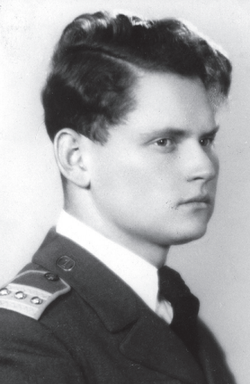
Hanka Václav Flight Lieutenant 83237
311 (Czechoslovak) Sqdn. Royal Air Force Volunteer Reserve
Václav Hanka was born on 7 November 1919 in Sokolnice, South Moravia, then part of Czechoslovakia. Educated at Brno Reálka; joined the Czechoslovak Air Force in 1937 as an observer-cadet. The Germans occupation began in March 1939, in December of that same year Václav made an unsuccessful attempt to leave the Protectorate in the direction of Hungary. A second attempt followed on 7 January 1940, when he was detained together with Major of the General Staff D. Marek and, after three months in prison, returned to the Slovak border.
A further attempt to cross succeeded, and through Yugoslavia, Greece, Turkey, the Middle East and Egypt he reached France, where he arrived on 6 May 1940. After its defeat he departed for England, where he was assigned to No. 311 (Czechoslovak) Bomber Squadron as an observer–navigator. After training he began operational flying on 3 March 1941.
In March 1942 Václav married twenty year old Betty Worboys in Wolverhampton, and the couple made their home at 65 Coalway Road. Their daughter, Rosemarie, was born in March 1943, a child Václav tragically never saw. The family’s sorrow deepened when Rosemarie died at the age of six.
Václav flew with 311 Squadron during its early period under Bomber Command, taking part in night bombing operations against German targets. He completed 20 operational sorties (106 flying hours) before the squadron transferred to Coastal Command in April 1942. There he continued front line service on long range anti-submarine patrols over the Bay of Biscay and the Western Approaches, flying a further 176 operational hours.
During the summer of 1942, Václav took part in several successful attacks on German U-boats, including the damaging and later confirmed sinking of U-165, under the command of Fregattenkapitän Eberhard Hoffmann, one of the squadron’s most notable achievements.
On 18 October 1942 Václav was travelling as a passenger aboard Vickers Wellington T2564 (KX-T), flying from RAF Talbenny, Pembrokeshire to RAF Northolt, South Ruislip, Headquarters Coastal Command.
The aircraft carried its normal crew of five plus ten additional Czechoslovak airmen.
During its approach to Northolt, the Wellington stalled at low altitude and crashed near South Ruislip Underground Station, killing all 15 airmen, a Belgium RAF officer who was Transport Officer at Talbenny and 6 civilians on the ground.
This was 311 Squadron’s greatest single loss of life during the war. Václav was 22 years old. At the request of Betty he was buried on 24 October 1942 at St Philip’s Churchyard, Penn Fields, Wolverhampton
He is also remembered on memorials in Sokolnice, Czech Republic.
In 1991 he was posthumously promoted to Lieutenant Colonel in the Czech forces.
